What happened
In a LangChain blog post published November 17, 2026, the company argues that the convergence of agent architectures around an LLM running in a loop, calling tools, and operating in a sandbox has led some AI engineers to conclude that the hard problems are solved. LangChain disagrees. The post identifies a step function change in how agents are being used: builders are increasingly thinking about proactive, always-on, goal-oriented agents. These share similarities with coding agents but introduce new context engineering challenges for which LangChain says it does not yet have general solutions.
Why it matters
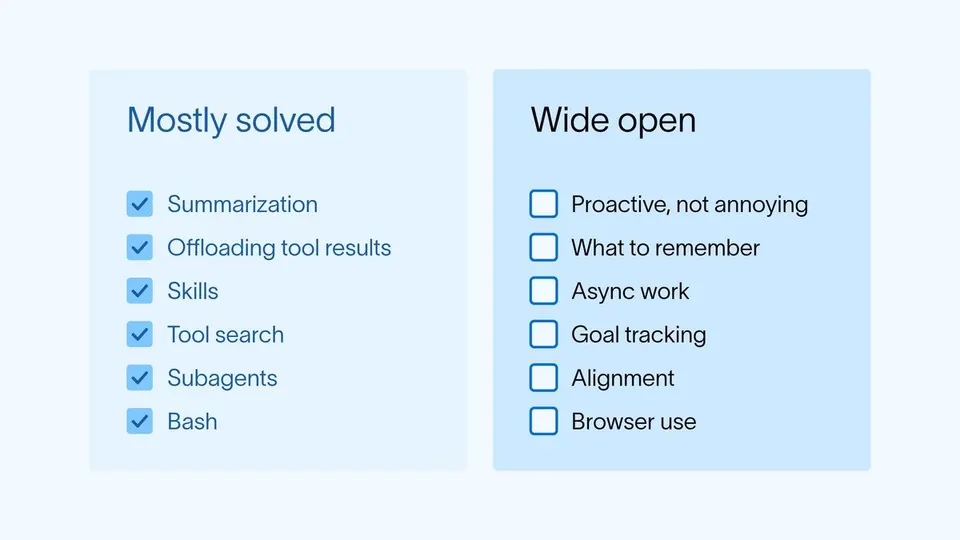
The post credits the convergence pattern to high-profile manifestations such as Claude Code, which it says came out over a year and a half ago, and LangChain's own Deep Agents harness, launched over a year ago. It also lists context engineering practices that have become standard: summarizing long threads when they exceed the context window, offloading large tool call results, skills for progressive disclosure, tool search to handle many tools, subagents for context isolation, and bash as a primary tool.
The shift matters because proactive agents run in the background, either listening to event feeds or woken up with heartbeats. That changes the engineering surface from task completion to continuous operation, goal pursuit, and interaction with long-running external systems.
Technical details
LangChain outlines several open problems:
- Proactivity calibration. Agents need to push things to the user to create a sense of helping, but too many notifications risk overwhelming them. Calibrating this is described as a hard context engineering challenge.
- Memory. Memory systems have two parts: an underlying data structure, often simple such as files or a single string, and an intelligence layer around the data. The hardest part is deciding what to remember. Remembering nothing or remembering overly granular details are both failure modes, and the intelligence layer that decides what to remember is often a simple agent itself.
- Async work. As agents and the tools and other agents they interact with run longer, more work moves into asynchronous tools and subagents. The post raises questions about notifying the main agent when work completes, handling whether the main agent is still running or has finished, and what happens when it is paused waiting for human approval.
- Goal tracking. Agents are moving from doing tasks to working toward goals, with Hone cited as an example. Challenges include getting agents to try new experiments rather than repeat things, to think about broad goals rather than small tasks, and to stay consistent over long time horizons.
- Alignment. Users will find it hard to design goals that agents cannot cheat. The post cites the classic example of "get rid of all bugs in codebase" leading to deleting the codebase entirely. Designing a harness that keeps agents focused without over-optimizing is an open question.
- Browser use. For coding agents the most important tool was bash. For general-purpose agents, the browser is becoming that tool, and it is more complicated to drive than a terminal. The post asks whether to interact with images or the DOM, both large objects, and how to manage context around them.
What to watch
LangChain frames these as unsolved problems rather than prescribing fixes. Teams building proactive agents should watch how notification calibration, memory selection policies, async completion signaling, and goal harness design evolve. The post also signals that browser interaction may become as central to general-purpose agents as bash is to coding agents, which raises immediate questions about context management for large visual and DOM inputs.