What happened
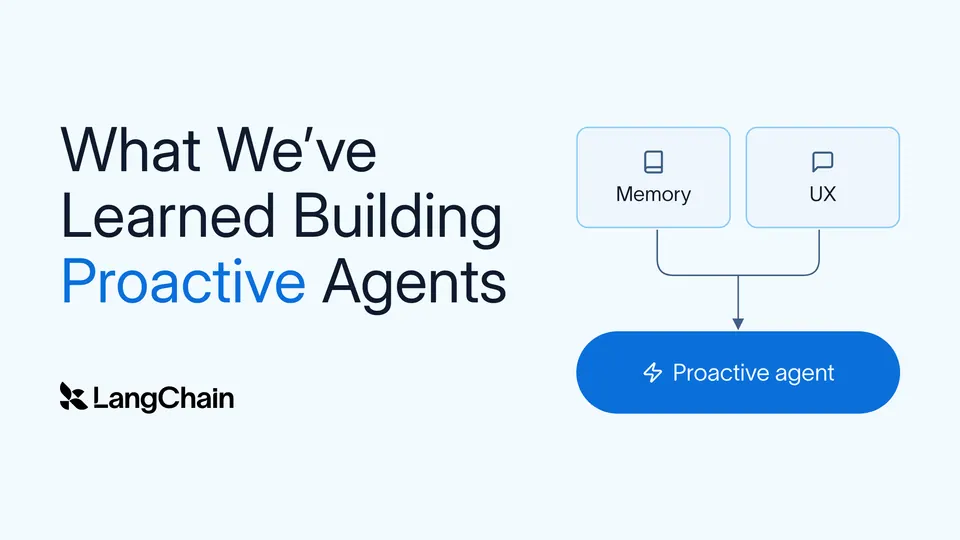
LangChain published an engineering post, What We've Learned Building Proactive Agents, describing how it builds and operates agents that run in the background toward goals rather than waiting for a prompt. The company says it runs two such agents internally: GTM Agent, a sales agent that watches for new leads and replies, sends daily briefs, and drafts outbound emails, and Robin (formerly Open SWE), an engineering agent that drafts pull requests and reviews every new one.
Both are built on Managed Deep Agents, and LangChain reports that more than 70% of runs on that platform now come from schedules rather than an ad hoc human prompt.
Why it matters
LangChain frames the shift as a change in the unit of work. It cites Hone, which describes its Engines as AI that is "assigned goals rather than tasks," and names Muse, Instinct, and OpenAI's dots as personal agents that popularized the proactive pattern. Goals, the post argues, let agents take on problems that play out over days or weeks.
The constraint that follows is human attention. LangChain compares a proactive agent to a new hire who earns larger tasks over time, and notes that once direct reports get good at their jobs, the manager can become the bottleneck. The same applies to agents: as they take on more goals, the user's attention becomes the scarce resource. LangChain treats memory and UX as the two essentials for spending that attention well.
Technical details
A proactive agent, per LangChain, responds to events from three sources: real-world events such as a new email or a newly opened pull request; schedules set by the developer, such as a nightly memory update or a weekly sweep for stale pull requests; and schedules the agent sets itself, such as a follow-up reminder or a daily brief a user requested. Robin's reviews start from a real-world event, while GTM Agent's daily brief runs on a schedule it created itself after a user asked for one.
Memory is the information an agent learns over time. Because a scheduled or event-triggered run arrives with no prompt, the agent's knowledge of user preferences comes from memory. LangChain identifies three signal types, tied to different points in time:
- Seed (past): precedent and existing context, for example seeding from a sent folder so an assistant knows how the user writes and who they work with.
- Feedback (present): the user's response to what the agent proposes, such as rewriting or rejecting a draft with a reason.
- Outcomes (future): what happens after the agent acts, such as a drafted email receiving a reply.
Storing memories is easy, LangChain says, often as simple as a file. Keeping them useful is harder, with three recurring problems: salience (deciding what is worth saving and how important it is), expiry (knowing when information goes stale, like a launch date that has passed), and duplication (merging new information instead of saving a contradictory second copy). Many proactive agents address this with "dreaming," a scheduled background job that reads recent traces and updates memory before the next run.
To judge whether memory helps, LangChain suggests tracking outcomes a good memory system should improve, such as how long drafts take to get approved or how often sent emails get replies, plus the share of check-ins the user actually acts on.
What to watch
LangChain argues memory is what builds trust and therefore autonomy: an agent that remembers feedback stops repeating mistakes, which earns it more latitude, such as booking meetings unsupervised once the user stops changing proposed times. On UX, the post notes that a proactive agent reaches out without being asked, usually with a question to answer or an action to approve, and how it presents those requests decides whether the user engages or mutes it. The post's published text ends mid-sentence in its UX section, so its full UX guidance is not yet available in the excerpt.