Meituan Tech has published a selection of its accepted papers for EMNLP 2026, the Association for Computational Linguistics conference on empirical methods in natural language processing. According to the Meituan Tech blog post, more than 20 papers from the team were accepted, and 12 main-conference long papers are highlighted. The selected work covers reasoning frameworks, policy optimization, evaluation, reinforcement learning, memory, adaptive training, semantic tagging, data synthesis, statistical frameworks, and reward models.
Why it matters
The collection reflects a focus on making LLM agents more efficient and self-sufficient. Several papers target the cost and latency of external components such as verifiers, skill libraries, and full database schemas. Others address evaluation and personalization, where generic benchmarks or outcome-only rewards can miss instruction-specific or user-specific behavior. For engineering teams building agentic systems, the recurring theme is reducing dependence on auxiliary infrastructure while preserving or improving task performance.
Technical details
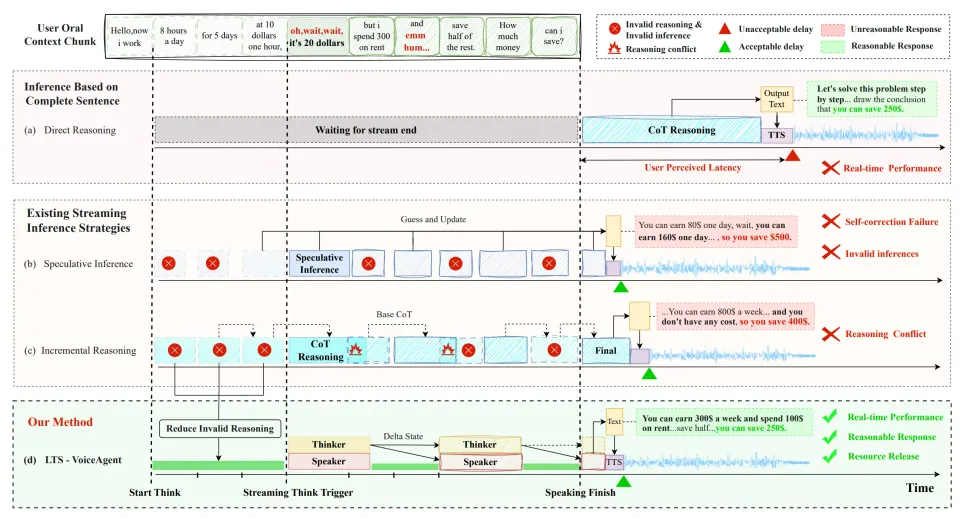
Streaming voice interaction. The LTS-Agent paper proposes a Listen-Think-Speak framework that separates when to think from how to reason incrementally. It introduces a Dynamic Semantic Trigger that activates at semantically saturated prefixes and a Dual-Role Stream Orchestrator that coordinates a background Thinker and a foreground Speaker. The authors report better accuracy-latency-efficiency trade-offs than serial cascades and existing streaming strategies on VERA, Spoken-MQA, BigBenchAudio, and a new Pause-and-Repair benchmark.
Reinforcement learning without external verifiers. Latent-GRPO uses geometric properties of the latent space to derive intrinsic rewards. The authors observe that terminal token representations of correct reasoning trajectories form tight clusters with high intra-class cosine similarity, while incorrect trajectories are dispersed. An Iterative Robust Centroid Estimation (IRCE) algorithm produces dense continuous rewards. Experiments across model scales show reasoning performance comparable to external verifiers with lower training latency and memory overhead.
Agent skill internalization. SIRI is a three-stage RL framework for autonomous skill discovery, validation, and internalization. On Qwen2.5-7B-Instruct, it improves GiGPO task success from 90.8% to 93.0% on ALFWorld and from 72.8% to 81.3% on WebShop. After training, the model uses only the original task prompt without retrieving or injecting skills.
Text-to-SQL over unknown schemas. TRUST-SQL models the task as a partially observable Markov decision process with an Explore-Propose-Generate-Confirm protocol and Phase-Aware GRPO. Without preloading schemas and using greedy decoding, 4B and 8B models improve average execution accuracy by 30.6 and 16.6 percentage points across five benchmarks. A 14B model reaches 68.1% on BIRD-Dev, or 70.1% with majority voting.
Memory and personalization. UniMem coordinates episodic and parametric memory through learnable routing tokens, automatically discovering task structure without task labels. TagPR introduces semantic tags into personalized reasoning chains and reports an average 32.65% improvement over base models across all LaMP tasks.
Evaluation and data synthesis. FlexBench/FlexEval generates instruction-conditioned test suites and reports that model rankings and failure modes vary significantly across nine target instructions and 3,888 generated dialogues. ToolForge synthesizes multi-hop, multi-turn, self-reflective tool-use data without large-scale online API calls; fine-tuning Qwen3-8B on 4,250 synthetic samples is reported to improve five out-of-domain QA benchmarks.
What to watch
The papers suggest that intrinsic reward signals, self-internalized skills, and adaptive memory routing are active directions for reducing agent infrastructure. The reported gains on ALFWorld, WebShop, BIRD-Dev, and LaMP provide concrete reference points, though results are tied to specific base models and benchmarks. Practitioners should watch for follow-up work on generalization across model families and on the overhead of the proposed routing and triggering mechanisms in production settings.