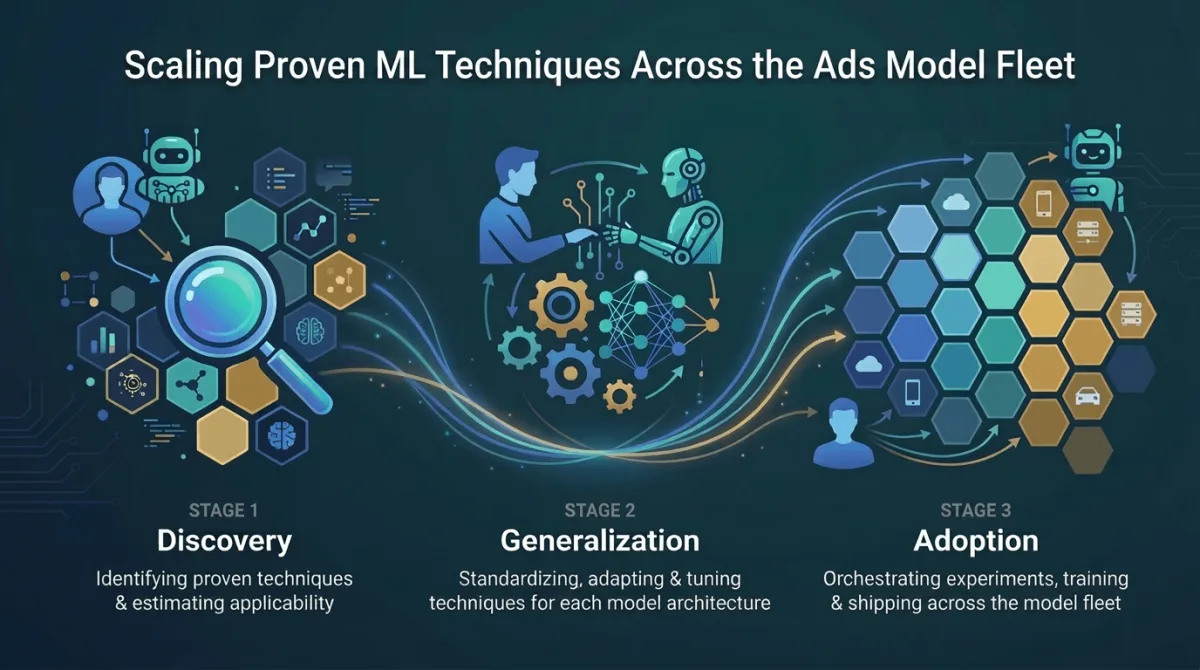
Meta has published a follow-up to its earlier post introducing the Ranking Engineer Agent (REA), an autonomous system that generates hypotheses, designs experiments, and proves new machine learning (ML) techniques on ads ranking models. The new post, on Engineering at Meta, focuses on the next step: propagating ranking model improvements such as architectural advancements and training optimizations efficiently across a large and diverse fleet of ads models.
Why it matters
Ads ranking systems at Meta's scale are not a single model but a fleet of models, and the company describes that fleet as large and diverse. Proving a technique works on one model is only part of the problem; the harder engineering question is how to carry a validated improvement across many models without repeating the full discovery and validation effort for each one. Meta frames the REA work as a way to scale ML innovation across that fleet, which places the agent in the role of both experimenter and distributor of proven techniques.
The post is the second in a series. The first installment introduced REA as an autonomous system for hypothesis generation, experiment design, and proof of new ML techniques on ads ranking models. This installment extends the scope from proving a technique to propagating it.
Technical details
According to the post, the improvements being propagated fall into categories including architectural advancements and training optimizations. The target of propagation is described as a large and diverse fleet of ads ranking models.
The source material does not disclose the number of models in the fleet, the specific architectures involved, the propagation mechanism, or any quantitative results from the effort. It also does not provide benchmarks, latency figures, or measured gains attributable to REA. Those details are absent from the available material and are therefore not reported here.
What the post does establish is the division of labor implied by the series: REA generates hypotheses, designs experiments, and proves new ML techniques on ads ranking models, and the follow-up work addresses how those proven improvements are then moved across the broader model fleet. Meta characterizes the goal as propagating improvements efficiently, though the source does not define the efficiency metric used.
What to watch
The post is a signal that Meta is treating agent-driven ML research as a pipeline with two distinct stages: discovery and propagation. For teams running many related models, the propagation stage is often where validated ideas stall, because each model requires its own integration and validation work. Meta's framing suggests it is applying autonomous agents to that second stage as well, not only to the initial hypothesis and experiment loop.
Readers should watch for subsequent posts in the series for the specifics the current material leaves out: how improvements are represented and transferred between models, how the agent handles the diversity of the fleet, and what measured impact the propagation effort produces. Until those details are published, the post should be read as a description of scope and intent rather than a report of quantified results.