Stripe has expanded its Treasury for agents product to include write access and customizable controls, allowing AI agents to move money on the platform. According to Stripe Engineering, more than 24,000 businesses already use Stripe Treasury for agents to give agents read access to financial data for tasks such as reviewing transactions, building cash flow models, and reconciling payments. The new capabilities, now in public preview, let agents transfer funds, convert currencies, and pay vendors within limits set by the business.
Why it matters
The shift from read-only to write access changes the role of agents in financial operations. Stripe frames the goal as enabling agents to complete end-to-end financial workflows, not just analyze the business but help run it. The company describes example use cases including a payables agent that monitors balances across accounts, transfers funds to keep bill pay accounts topped up, and prepares vendor payments, and a payroll agent that converts currencies and moves money into the right accounts so employees are paid on time.
The engineering challenge is not only granting capability but constraining it. Stripe's announcement emphasizes that agents need access to the right capabilities alongside clear limits on what they can do. The design reflects a broader pattern in agentic systems: separating the agent's identity and permissions from the human user's, and inserting approval gates where actions carry financial risk.
Technical details
Businesses connect agents to Stripe through the company's Model Context Protocol (MCP) server by linking a compatible AI tool, such as Claude or Codex, and choosing what Stripe data the agent can see, which actions it can take, and when human approval is required.
Stripe describes two connection models:
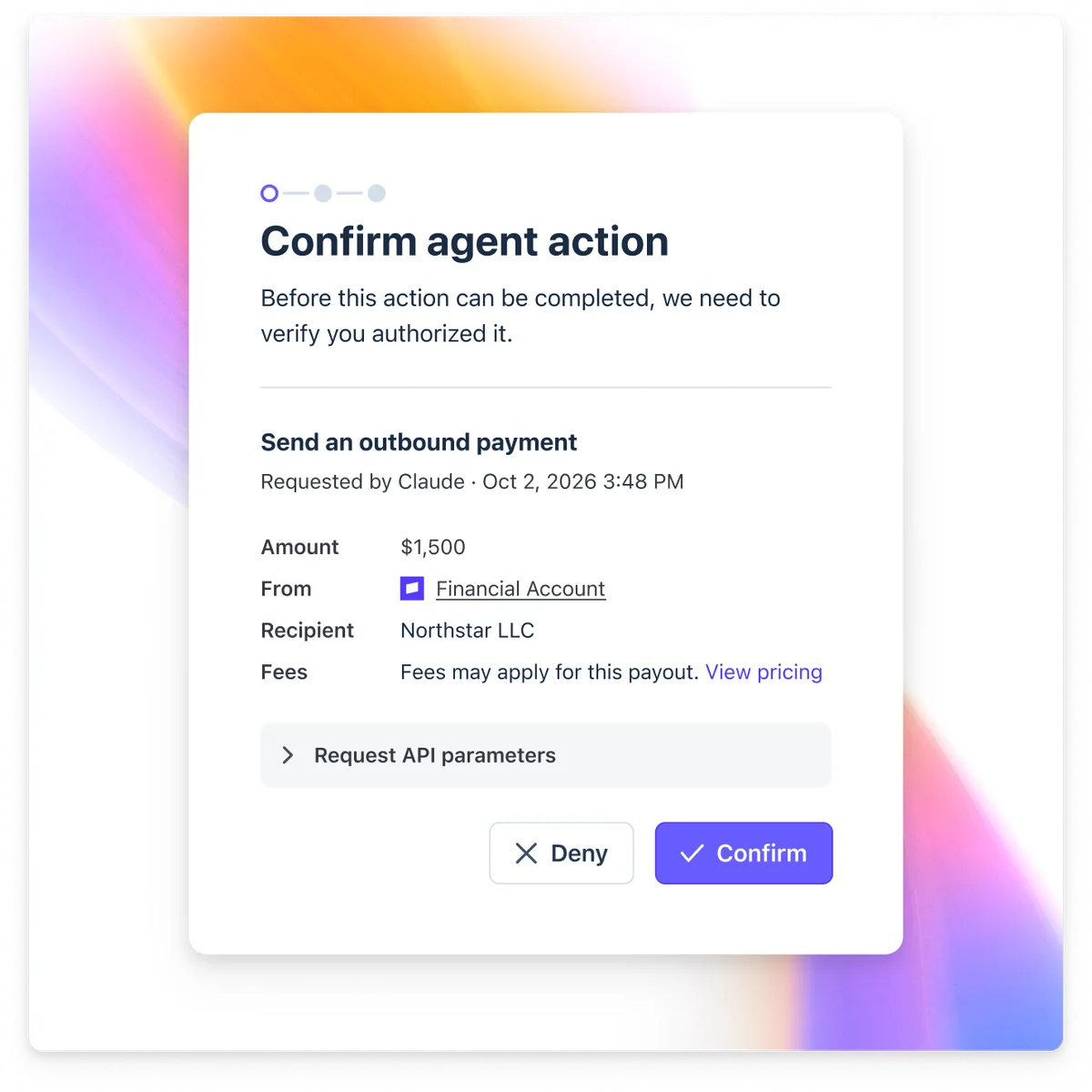
- Authorized user via OAuth. The agent acts as an extension of a user and inherits that user's permissions. Every action that moves money, including a refund or payout, must be confirmed before completion.
- Agent identity via API key. The agent receives its own identity and persistent access through an agent API key. The business sets the key's permissions, expiration date, and rotation schedule. This allows the agent to work in the background, such as preparing reports overnight, without waiting for a user prompt.
By default, agent-initiated refunds, payouts, and outbound transfers require human approval. Unlike OAuth, agent API keys allow businesses to adapt rules for specific actions. Stripe gives the example of an agent processing an ACH transfer under $50 automatically while routing larger transfers for approval. Businesses can also create custom approval rules for other agent actions, such as adding or removing an account administrator or updating a bank account.
Stripe notes that when a business uses Stripe for both payment processing and banking through Treasury, agents can see incoming payments, funds across Stripe balances and financial accounts, and outgoing transfers. This unified view lets an agent, for example, create a daily financial report combining incoming payments, balances, card spend, and bills paid, or link incoming payments to upcoming bills, anticipate a shortfall, prioritize overdue invoices, and follow up with customers.
What to watch
Stripe says it plans to expand the financial actions agents can take, including creating cards with spending limits. The company describes a longer-term direction in which agents proactively identify what needs attention and help take care of it, with businesses deciding how far agents can go.
For teams evaluating agentic finance workflows, the key design questions are the ones Stripe's two connection models surface: whether an agent should inherit a human's permissions or carry its own identity, how approval thresholds should be set for money-moving actions, and how key rotation and expiration are managed for background agents. Stripe's public preview makes these controls available now, with the caveat that the set of permitted actions is expected to grow.