What happened
Meta's ads ranking systems serve billions of daily requests across many products and optimization goals, supported by a large number of production models. In a post on Engineering at Meta, the company described a template-driven approach it calls Standard Model Templates (SMT), which standardizes model design into a small set of reusable, composable building blocks. According to Meta, over the last two years the approach reduced per-model engineering time by 92%, shipped 5000+ technique-model combinations, improved offline model quality by 0.63% on average at neutral serving capacity, and delivered 0.86% cumulative online lift covering 70% of models by count. The work is detailed in a paper titled "Design Once, Deploy at Scale: Template-Driven ML Development for Large Model Ecosystems."
Why it matters
Meta frames the core problem as propagation rather than invention. At the scale of its ads ranking fleet, the bottleneck is no longer inventing new techniques but shipping them reliably across a fragmented model space. Fragmentation compounds: a new architecture may land on one model while reaching every corner of the ecosystem takes years, and a platform migration that works for one model family can break on a long tail of specialized configurations. Meta describes this as an unfavorable scaling law for engineering, where work grows linearly with the number of models if each idea must be evaluated and adapted per model. Fragmentation also weakens automation, because AutoML and optimization systems work best in a structured space. Meta's answer was not another layer of automation but reducing the complexity itself.
Technical details
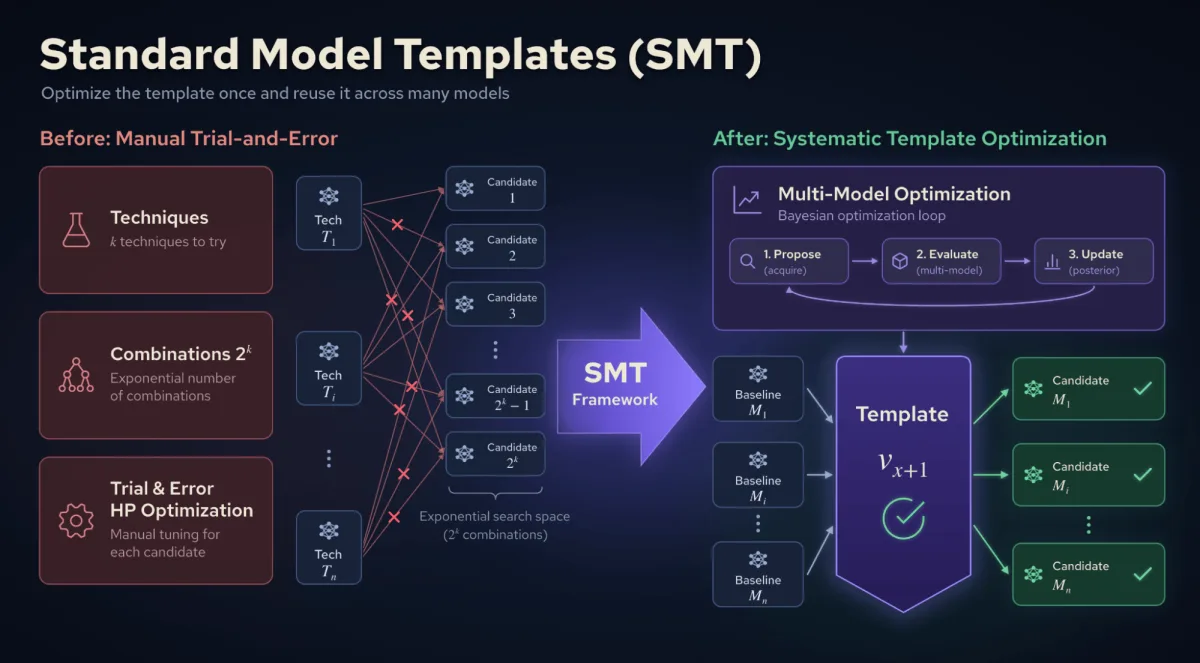
A template is described as an opinionated, minimal model setup built from shared components including architecture choices, feature logic, training settings, and serving configs. Meta uses a small set of templates covering major ranking and retrieval patterns across different model sizes, packaging reusable components for feature selection, feature interaction, model parallelism, training configuration, and hardware-aware serving. Model-specific logic still exists where necessary, but common parts are explicitly represented and shared.
The operating model shifts from per-model iteration to template-level iteration. Instead of evaluating a new idea independently on every model, Meta evaluates it on a smaller set of representative templates and propagates it to the model groups that use them. Meta cites three advantages: reduced propagation complexity, because one implementation serves many downstream models; improved reliability, because fewer unique setups make stronger validation, guardrails, and transferable debugging workflows practical; and improved predictability, because performance on representative models becomes a better signal for the rest of the group. In the SMT development loop, techniques are tuned once across representative models, added to a new template version, and rolled out to every model built on it.
What to watch
The reported gains are specific to Meta's ads ranking ecosystem, and the post does not detail how the templates handle the long tail of specialized configurations beyond noting that model-specific logic remains where necessary. The 0.86% cumulative online lift covers 70% of models by count, which leaves a portion of the fleet outside the reported effect. Teams considering a similar approach may want to track how template versioning and rollout interact with existing AutoML and optimization systems, since Meta argues those systems perform best in a structured space. The full methodology is documented in the accompanying paper.